Movies/ Mouthing Off/ A Miscellany

Movies/ Mouthing Off/ A Miscellany

Thursday, February 26, 2015

Plastic Augury, or the Unexpected Drama of Disfiguration


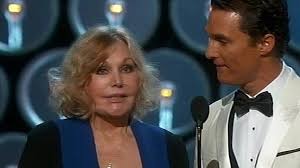
These days when actresses sashay down the red carpet, we look to see not whose dress, but whose face they have donned for the occasion. For example, recently Renee Zellweger tried out Robin Wright’s face for size. While undoubtedly amusing and profitable for everyone involved, especially internet commentators, occasionally things veer into the downright terrifying. Yes, I’m talking about last year’s abyss-peering Oscar ceremony.
kim.jpg


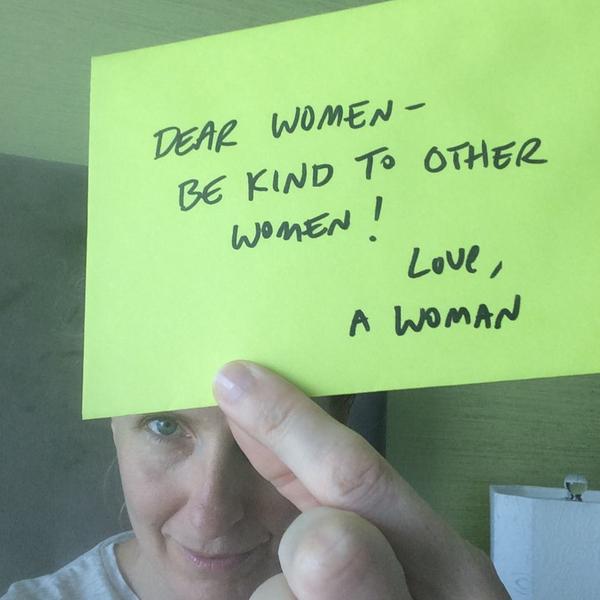
I know, I know -- it seems women are damned if they don’t, and double damned if they do. And I have been reminded by author and enlightened being, Elizabeth Gilbert (Eat Pray Love) that the kindest thing to do is to look away
gilbert.jpg


What, exactly, has ever been solved by the genteel lookaway? This shit is oppressive. I don't respect clitorectomy as a choice either.
And though the truly ghoulish products of this process (Goldie Hawn, anyone?) were ostentatiously swept under the red carpet this year, where we were only allowed the eminently presentable Meryl Streep and Julie Andrews, the extreme pressure to look a certain way and never age is, inevitably, showing up in the work.
Many people thought Jennifer Aniston’s performance in Cake was unfairly overlooked. (Neil Patrick Harris pointedly said she deserved to be there.) All the things that were said about Still Alice -- that it was a great performance in a so-so film (I’ll get to that later)--are actually true of Cake-- Aniston’s is a transformative performance in the middle of an inert mess. It’s true that the details of the film don’t make sense -- how does a disabled lawyer, traumatized by a catastrophic car wreck, afford a classic mid-century home in the Hollywood Hills, especially now that she is no longer living with her husband --a federal employee,  so no answers there money-wise.


jennifer.jpg
These loose threads, while troublesome, don’t finally undermine the power of her performance, mostly because in some crucial way Aniston is playing herself as much as the character I see credited as both Claire Bennet and Claire Simmons on IMDB. See, it really doesn’t matter. This is Aniston is all her lithe glory, but massively scarred and racked with pain. The part inevitably ricochets off our tabloids image of her as a poor little rich girl, unable to hold a man or have a child. She hobbles through her glamorous gem of a house, sneaking pain killers squirreled away behind the original art adorning the walls, while she fitfully attends various therapies and tries to get her shit together.
Response to the role inevitably clustered around ideas of the suffering movie star fighting her way back, though the theme was clearly not deemed as worthy as in the catastrophically male BirdMAN. Manohla Dargis commends “a slight hardness” invoking “midcareer Ginger Rogers” -- invoking a classic movie star. I was reminded strongly of Sunset Boulevard, with the aging, doomed not-movie-star circling the pool with her inexplicably loyal  foreign servant forever at her side (the treatment of Mexican actress Adriana Barraza deserves a column of its own.)
Though the movie inserts a buoyant ending, the Academy provided the what seems the rightful verdict: Damaged Goods. Do Not Pass Go. She was still welcome on the red carpet, however, asserting  her  buoyancy in time-tested fashion.

anis.jpg
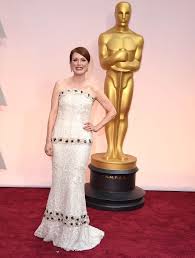
Julianna Moore, in contrast, was the queen of the evening, with a dress to match. The Los Angeles Times reports that Moore’s Chanel dress contained 80,000 hand painted sequins and flowers, and took 27 people 987 hours to make.

moore.jpg


When Moore collected the Best Actress statuette late in Sunday’s ceremony, she was clearly claiming what was rightfully hers.  In a career filled with spectacular performances, some features of the “Moore” role stand out. From the beginning, she was a very sexual presence, unafraid to put herself forward in that way. It’s hard to believe it was over 20 years ago she made a splash wearing in Robert Altman’s Short Cuts. Hard to forget her memorable scene fighting with movie husband Mathew Modine while wearing no bottoms, her red pubic hair on full display. Here was somebody demanding to be noticed on multiple levels.
In recent years, Moore’s performance’s have continued to be very sexy, but with an overlay of poignance perhaps inevitable for a Hollywood actress approaching 60 (She is currently 54.). The part the Academy chose to award her for, after being nominated four other times, is an interesting departure, emphasizing extreme professional competence.

alice.jpg


Moore plays a Columbia linguistics professor confronted with her own waning powers in the grip of early-onset Alzheimer’s disease. The emphasis is on Alice’s amazing accomplishments and the matching scope of her loss: inevitably the parallel with Moore’s own incredibly distinguished career suggests itself and lends an extra intensity. What exactly are the prospects for a leading lady heading toward 60?
The  husband writing/directing team of Richard Glatzer and Wash Westmoreland has not been shy about extending the Alzheimer’s as metaphor in the film itself and in their public discussions of the film. Alice’s daughter in the film, played by Kristen Stewart, is an actress appearing in Angels in America, a work that is also quoted extensively in the film, inevitably suggesting the plight of AIDS sufferers disappearing before their time. And, as Moore mentioned in her acceptance speech, Richard Glatzer is succumbing to ALS; this film is, in a sense, his swan song. When his Westmoreland asked him about his remaining time, Moore recounted onstage, he said he wanted to spend it doing what he loved: making movies.Though her own plight was left unspoken, Moore, Oscar in hand, must have been contemplating her own imminent oblivion.
As usual, Patricia Arquette’s body language was at least as articulate as her passionate acceptance speech. Here’s a 46-year-old woman, unstarved, wearing reading glasses: Equal rights to age onstage now.

--Grace Lovelace


Thursday, January 1, 2015

Now on Netflix Instant: Photographic Memory/ Stories We Tell

For some reason, I’ve always had a soft spot for the documentary Sherman’s March (1985). It’s not actually about Sherman or the Civil War, but instead is a resolute avoidance of its declared topic. Ross McElwee somehow procured funding for a documentary on the lingering effects of Sherman’s merciless campaign 1864 campaign through the South, and then spent it making, well, I'm not sure how to characterize what he ended up with.


Anything I know about Sherman and the Civil War, I most assuredly did not pick up from McElwee’s fly-away, free-associative film, which devolves into a series of monologues on procrastination broken up by flirtations with a series of Southern, well, I wouldn’t exactly call them belles. The most entertaining among them (with some possible competition from a hippie-linguist completing her thesis on a deserted island in the Carolinas)  is Patricia “Pat” Rendleman, a beautiful nutcase, I mean aspiring actress, who allows McElwee to film her rollerblading, doing freeform Jane Fonda era calisthenics, swimming, and roller-blading some more in a series of provocative early eighties outfits.
pat.jpg
Patricia "Pat" Rendleman


Unfortunately, Rendleman takes off for Atlanta in pursuit of the elusive Burt Reynolds, whom she somewhat mysteriously considers the key to her personal and professional future. She’s deaf to McElwee’s claims (borne out by a quick look at IMDB) that his film could in fact be her big breakthrough.
His picaresque adventures through the South and its women continue,  completely independent of the Civil war, apart from some vague gesturing on McElwee’s part. The whole thing is less Ken Burns and more proto-reality show -- sort of Annie Hall meets The Real Housewives of Atlanta.
Given my excessive attachment to Sherman’s March, I was pleased to discover a newer effort, Photographic Memory (2011) available for viewing on Netflix.


Photographic Memory finds McElwee having abandoned all historiographical aspirations, but carrying a good deal of baggage. The 25 year interval following Sherman’s March finds McElwee a family man; indeed, the film is dedicated to his son, Adrian, who is its major subject. Photographic Memory alternates footage of him as a beloved toddler and young children with that of the intractable adolescent McElwee believes he has become. Their previously idyllic relationship has become fraught, as Adrian ceases to gaze adoringly at his father and begins to pursue his own interest in making extreme sports videos, filming himself skiing backwards while stoned and similar stunts. “How many teenagers have been saved by our visions of the beautiful children they used to be, “ intones McElwee in his familiar Southern twang, his voice gone sour.

Not that McElwee has lost his taste for the broader gesture--running through his commentary about his son is the suggestion that his son’s problems--specifically his scattered attention and his servitude to electronic devices--are those of an entire generation. From his newfound position of gravitas McElwee diagnoses his son, and his entire cohort, with ADD.
skiing.jpg
Adrian McElwee in extreme sports mode
For someone who watches the two films in tandem, the ironies come thick and fast.The flippertigibbet of Sherman’s March has become the elder statesman of Photographic Memory. The crazy part is that  essentially Sherman’s March is a paean to ADD and to flitting around at whim.
And it’s not like the middle-aged McElwee has outgrown these tendencies; though the film is, at its core, about his relationship with his son, he suddenly decides to take off to Brittany and revisit his own past as a photographer. Suddenly we are in a whole different story, concerning a swinging Frenchman’s fall from grace, replete with interviews with his widow and some of his lovers. While mildly engaging, it must be said: a lot of this plays like so much stoned backwards-skiing.
It’s easy to see where Adrian got these tendencies; one of the more perverse satisfactions of Photographic Memory is seeing into the areas of McElwee’s psyche where he appears most blind. On the other hand, his own blindness is part of the film. In the end the film, while fitfullly illuminating, has a lost, melancholic tone: this is the unmistakably creaky sound of aging in action.
If Ross McElwee’s insights as a filmmaking can feel wispy and incidental, with Sarah Polley’s own family documentary, Stories We Tell, we are in the hands of a commanding artist.

But Polley seemed to arrive that way. It made sense, at the beginning to see her as an “actors’ director” since she came from an acting background. (Her most famous film was The Sweet Hereafter, afterwards it seemed like maybe this had been some sort of apprenticeship with its intense, idionsyncratic writer/director, Atom Egoyan.)
Away From Her  drew an astonishing, Academy award nominated performance from Julie Christie. The concept itself of an aged women beginning to suffer from dementia also being chic and sexual itself seemed incredibly startling and provocative. (I can’t help but this that it was an influence on the current Julianne Moore release Still Alice.) 
Julie Christie in Away From Her

Polley adapted Away From Her from an Alice Munro story;by her next film, Take this Waltz, she was writing the whole thing. This almost willfully slight film also is quite innovative in its treatment of women’s sexuality and marriage. These themes make a good deal of sense when we learn about the dramatic story of Polley’s mother in her next film, Stories We Tell.
I don’t want to reduce the impact by giving away too much of Stories We Tell, since the pacing is highly dramatic. I will say there are major revelations throughout, including in the very last frame. That Polley chose to go from a successful career making feature films to making a documentary itself seems to upend convention; usually you’d expect a director to swim fiercely toward the mainstream.
But Polley has always seemed to enjoy defying Hollywood's social Darwinism. For my part, I don’t see why she isn’t a bigger deal; but, in a way, she doesn’t seem to crave Angelina Jolie levels of attention. Maybe that’s part of the documentary thing, besides having a fascinating story to tell; she is able to operate, still, somewhat under the radar of the culture machine.
Maybe it’s because she’s Canadian. In any case, I consider her a treasure, national or not.
[Sherman’s March, Photographic Memory, Take this Waltz, and Stories We Tell are all currently available on Netflix Instant.]

--Grace Lovelace

Sunday, August 31, 2014

The Hardest Working Biopic: Get On Up Movie Review


The musical biopic has proved surprisingly durable and accommodating. Who would have figured almost seventy years after the Cole Porter biography Night and Day (1946) would bring us Get On Up (2014), a picture just as tuneful and, in its 21st century way, just as dissimulating concerning the actual stuff of its subject’s life?
james brown.jpg
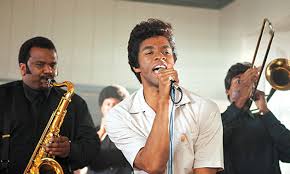
Chadwick Boseman as James Brown


In some ways we’ve come a long way since the days when Cole Porter’s sexuality was completely concealed in his own life story, even while hiding in plain sight in his lyrics. Get on Up, features a remarkable scene with a provocative, sexually transgressive Little Richard (Brandon Smith), as well as touching, albeit fleetingly, on some of the more painful aspects of the James Brown story: beginning with his abject poverty in Barnwell, South Carolina, though life in a Georgia whorehouse (run by his grandmother), and including incarceration as a teen for stealing a suit. Yet the genius(?) of Get On Up renders a term in a fifties jailhouse in the South as sprightly as the Yale Glee Club.


In fact, it all glides along so darn smoothly that I had trouble reconciling this James Brown with the man whose name appeared in eighties’ talk show monologues as a caricature of rock star excess and abuse. Get On Up has many virtues (I’ll get to those later), but verisimilitude does not happen to be one of them. While it might seem perverse to structure a movie about a man who famously ran through wives and band-members like water around the idea of his evolving interpersonal skills, insofar as Get on Up can be said to have a particular approach, this is it. (Director Taylor Hackford applies the same thick gloss matte here that he did in The Help,  a  style which renders even shit pie an amusing trifle. I’d say this was merely a matter of cinematography except that it very much extends to the emotional life of the characters. )


From a narrative point of view, it’s fascinating to consider the ways in which Get on Up both entertains and exorcises Brown’s volatile relationships. The film must deal with his monomaniacal control issues, but chooses to do so through the lens of two enduring relationships.
The first of these two totemic figures is based on long-time band-member Bobby Byrd, a real person. In the film, it’s Brown who helps secure early release from jail for the talented young singer, and, even as the rest of The Famous Flames, the group with whom Brown makes his first recordings but which disbanded as Brown increasingly seized control and credit. Byrd, a real person, also represents a rationale for Brown’s dictatorial behavior within the band. In several key scenes where Brown repeatedly fines, berates and otherwise is borderline abusive with his band, Byrd is shown loyally sticking with his friend even as others depart in droves, muttering imprecations.  
Byrd was in fact a real musician, but within the film he is very much the audience’s stand-in, justifying with his presence and periodically with noble speeches, why we might want to stick with this turkey over the long haul.
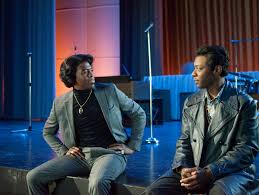
James Brown (Chadwick Boseman) with Bobby Byrd (Nelsan Ellis)


The answer, rendered explicitly on numerous occasions by Nelsan Ellis as Bobby Byrd, is that James Brown is a remarkable genius who will be remembered by history. Byrd is seen as wisely seizing his chance to support someone truly exceptional, continuously reinforcing this point by his own ongoing presence in the film while legions of other musicians fall by the wayside, whiny and exchangeable.
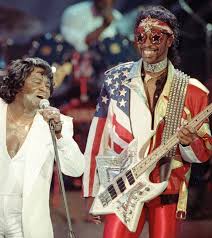
This rendering is plausible, sort of true, and also highly strategic. While focusing on a musician of mediocre talent who is content to remain a supporting player to one of history’s greats, Get On Up discounts the contributions of the many extremely talented players who went on to successful music careers of their own. Included among these is Bootsy Collins, whose name is ever-so-briefly heard in the air, but who receives almost no screen time.
Real life James Brown with equally real Bootsy Collins


In real life, Collins has recounted how at first he adored Brown as the father he never had, then, in light of subsequent experiences, decided fathers were on the whole overrated.
Collins’ story, willfully excluded in the film, shows that the circuit of Brown’s creativity did not work in one direction: he drew enormous amounts from the young, energetic performers he was so good at attracting, but through his inability to collaborate, invariably forced to move on.


But at least there was a Bobby Byrd, and he did stay in the band longer than most. The way the film treats Brown’s wife, DeeDee, moves much closer to actual deception. For one thing, the movie leaves the distinct impression that Brown had one early marriage, then moved on to the woman with whom he spent the rest of his life (In reality, Brown was married four times.). But more troubling is the film deals with Brown’s violence toward women, unavoidable since it erupted very publicly at various points in his career.
Get on Up  deals with the subject in a pair of very deceptive scenes. In one, Brown generously, if maybe a bit ostentatiously, hands out silver dollars for Christmas in front of the impressive house he’s acquired, spies a white neighbor looking down DeeDee’s low-cut elf suit. When they go in the house, a confused and upset Brown hits DeeDee, who we then see weeping on the floor. In a paired scene, however, Brown once again berates DeeDee for looking too sexy and available at a party and seems on the verge of striking her again. Instead she deflects him with a joke, and they begin a pre-coital dance on the bed.
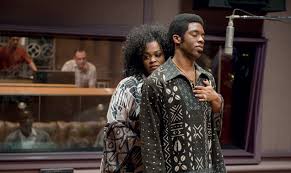
Loyal wife DeeDee Brown (Jill Scott) holds James Brown (Chadwick Boseman)


Without any actual lies, we are given the emotional impression that the blows were an exceptional occurrence, one that was resolved as Brown and his marriage matured. The reality was more wives and more beatings.


The young British screenwriting duo Jez and John Henry Butterworth (brothers) have crafted an unusual, ever-shifting chronology that easily facilitates such sleights of hand. There are many admirable things about this structure, for one thing it lends a fresh feel to the storytelling. They don’t have to belabor the connections between early life and later behavior that quickly become tiresome in the usual bio-pic. The Butterworths make the admirable discovery that you can make the same point more powerfully and economically simply by juxtaposing the two points in time.


The Butterworths, who won a Writers’ Guild award for their screenplay about the Valerie Plame Wilson affair, Fair Game,  seem to have picked up a thing or two in their time with spies about the strategic deployment of information. When a simple shift in focus or tone can convey the intended impression, there is no need for the uncouthness of a lie. Whether they learned from Karl Rove that facts are simply what you need at the moment, or from Quentin Tarantino that they are simply an element of historical wish-enactment, postmodern cinema takes only the most passing interest in reality.


In that it resembles the old cinema: In any case, Get On Up is, righteously enough, more interested in Brown's musical legacy than his personal life. The film, rated PG13, is clearly intended to win over the several generations since James Brown held the world stage and helped invent rock and roll. Where Get On Up shines is in tracing the origins of the Brown’s music, and explaining non-didactically, what made it so different, and most of all, recreating the astounding performances which made his name.


M
In many ways James Brown, of all performers, is perfect for the screen. Known just as much for his stagecraft and, of course, his dancing, as for his actual songs, Get on Up really delivers in the performance scenes. With its extraordinarily engaging star, Chadwick Boseman, recreating the famous Brown moves while he lip-syncs to the actual Brown vocals, we get a sense of all the things that can’t be conveyed on a piece of vinyl, much less some disembodied electronic download. James Brown groupies like producer Mick Jagger, and co-star Dan Aykroyd are finally less interested in the specifics of a tortured life than in passing on an ecstatic and influential sound. They are less biographers in a strict sense than Fishers of Soul-Men.
History is written by the victors


This is hagiography with an infectious beat. And after several hours dancing in the dark in my theater seat, the film did its work. Count me a latter-day convert to the Church of Funk.

I was blind, but now I see. --Grace Lovelace


Friday, August 8, 2014

Film Review | A Summer's Tale

“To watch a film like this, or any Rohmer film, creates a sense of peaceful regard in me. He isn't afraid of losing my attention with too much dialogue, or too little action.” -- Roger Ebert


“There are no indications of prurience.” -- Stephen Holden


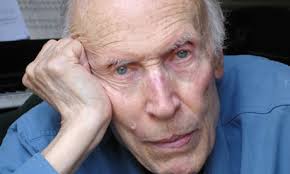
Eric Rohmer
Much as I love ridiculing the prurience and luxuriant boredom of Eric Rohmer’s Moral Tales, at this point I’m concerned no one will know what I'm making fun of. (For example, I like to say 1969’s My Night at Maud’s was outlawed as torture along with waterboarding under the Obama administration because of its excruciatingly slow pace.) A must-see for the culturally informed in the sixties and seventies, Rohmer's low-key films sort of fell out of fashion over the ensuing decades. Indeed Rohmer's 1996 effort, A Summer's Tale has only now found American distribution, four years after his death and nearly twenty after its release in France.

When I made my pilgrimage to Santa Monica, the closest place for viewing arty French films, there were indications that in spite of this recent release, Rohmer doesn't have much of a future popular audience-wise. There were a smattering of senior francophiles with their accoutrement: oxygen tanks, walkers, cravats. I was the youngest by far in the theater, and that's not young. What were the chances my internet audience would have any interest in an increasingly obscure French filmmaker?


But then a vision of the highly successful Criterion video campaign appeared before me.
Claire's Knee (1970)


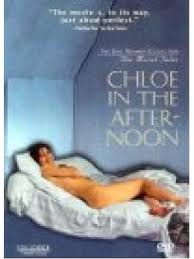
You see, I know just how successful these slick, suggestive images were in moving the merchandise because I worked in a video store for a time in the late eighties. We carried a pretty large selection of foreign films, but the Rohmer films were almost always rented out. And not by the serious middle aged people who occasionally took out Rashomon  or Persona; no, these films were going out to young men, droves of them.
     
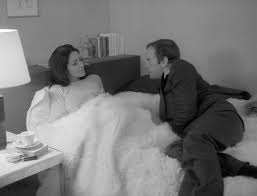
Self-explanatory, 1972
                                              
After I watched a few of his films, particularly his breakthrough film, the interminable aforementioned My Night at Maud’s (1969), I was forced to confront the unbelievable paradox of his video popularity. Talk about bait and switch: In Maud, this engineer/former seminary student goes around debating fine point of theology for 105 minute, which even though I just looked it up on imdb is hard to believe. It seems so much longer.
Oh, I think there are a couple girls who might take off some clothes (not too many!)  whilst discussing the holy ghost. For a child born in sixties southern California, this was profoundly foreign and off-putting. It's possible I left my body a few times. And I’m not the only one. To quote from the Wikipedia entry on Rohmer: "His style was famously criticised by Gene Hackman's character in the 1975 film Night Moves who describes viewing Rohmer's films as "kind of like watching paint dry.”
maud.jpg
The infamous My Night at Maud's


After I saw a few of Rohmer's films, I felt it my duty as a responsible video store employee to inform these young men what they were paying for. “You know this movie is in black and white, right? And it has a lot of talking. . .in French!” In return for my vigilance I got nothing but horrified looks, looks that declared, "I'm all about art," And "Back off!" So after a few attempts, I abandoned my post as consumer watchdog. From now on, it was their funeral.

My (Mild) Conversion


I assume this aspect of Rohmer's career in video rentals was curtailed with the advent of readily available internet pornography, From now on, there would be no need to sublimate in the foreign film section (correction: from the looks of it, some persists on Netflix.) The video stores themselves have disappeared, for that matter.
Yet the rare longevity of Rohmer's film career attests he had something to offer.


He really did have a remarkable enduring career. Part of the French New Wave, he edited Cahiers du Cinema in the years when Jean-Luc Godard and Francois Truffaut worked as film critics on the magazine. In fact, one of his first short films was made in collaboration with Godard, and Truffaut funded  My Night at Maud’s. Remarkably, since their style seem very dissimilar, he wrote the first book on Hitchcock. But nothing is more striking about his life as a filmmaker than its simple duration.
Eric Rohmer


Rohmer made films for an astonishing 50 years. And when you compare him to the few directors of comparable longevity--Woody Allen springs to mind--he appears even more impressive. Unlike Allen, he has actually improved with age. I think they call it maturing, and it’s something of a miracle wherever you find it.


Rohmer tended to make films in large thematic groupings: the “Six Moral Tales” which made his name; his mid-period “Comedies and Proverbs”; and the late “Tales of the Four Seasons” (by far my favorite). Like Shakespeare’s final plays, Rohmer’s show a shift, or rather, a broadening in perspective.


Is it possible for divine intervention to work itself out through the hassles and delays of foreign film distribution? Because the nearly twenty year delay before A Summer’s Tale was released in the U.S. enhances its low-key charms considerably. There are no cell-phones or computers; the beautiful young people who populate its shores seem like messengers from a simpler era, forced to deal with each other directly without any kind of social media to take the edge off the boredom and drift of actual interaction.
A Summer's Tale takes place in Dinard, a tourist town on the coast of Brittany. Gaspard (Melvil Poupaud), a young mathematician who also happens to be a gifted musician, wiles away a few weeks in a borrowed room, waiting for a girl, Lena, a girl he was tenuously involved with, who may or may not show up (She is largely absent from the film, although she makes a brief appearance toward the end, pretty in her bikini but almost as unavailable in the flesh and she was off-stage.)  Although withdrawn and self-conscious, he strikes up an inpromptu friendship with a waitress  named Margot (Amanda Langlet) (who turns out to have a PhD in ethnography) and begins yet another sexual flirtation with the intense, demanding Solène (Gwenaelle Simon).

Gaspard is amusingly unmoored, drawn to whichever of these wildly disparate woman pays him attention in the moment (though this being Eric Rohmer, they are similar inl looking superb in bikinis). Rohmer enjoys playing off the fact that this self-serious, intellectual young man is stupidly at the mercy of the free-floating sexual energy surrounding him in this ancient beach town. The movie is partly a story of Gaspard maturing to the point that he could make a decent partner to the clear front runner among his prospective partners: Margot, the intellectual waitress who, in stark contrast with Gaspard, is both interested and available to everyone (she explains this as part of her role as an ethnographer), especially people unlike herself.


As I made my way out of the theater I heard one of the aging Francophiles in attendance. “I just wanted to shake that young man. I mean, they’re all pretty, but one of those girls is an real pearl!” There are, in fact, all kinds of indications that she is “the one,” including that, somewhat unusually for Rohmer, she is a returning player. She played a pivotal part as Pauline in a film from an earlier series, Pauline at the Beach (1983).
young amanda.jpg
Amanda Langlet, Pauline at the Beach


In that film she was the ingenue Pauline, watching her more experienced aunt juggle a number of men. By A Summer's Tale she is the more seasoned character, gently schooling Gaspard in the things that endure and choices that should be made.
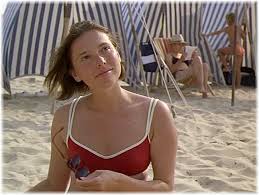
older amanda.jpg
Amanda Langlet, A Summer's Tale


She seems to be interested in him; the general drift of the film is that they will end up together at some point, “in winter, the best season,” as Margot suggests as one point. But she, like Rohmer himself, seems in no hurry. In stark contrast to his contemporaries like Woody Allen, or his old Cahiers du Cinema colleague Jean-Luc Godard, there is nary a trace of misogyny or misanthropy in the "Seasons" films. He has attained a kind of serenity and seems to simply enjoy the play of the water, the sun, and the free-floating sexual energy. To put it in Californian, he's totally mellow.

When I first viewed the films of Eric Rohmer they struck me as willfully stripped down and boring, but by the time I got to this sea-side film, twenty years later, it struck me as almost visionary in its simplicity. There are no cell-phones (uncommon at that time) or even computers (Rohmer's own call); as usual, Rohmer does not use non-ambient music; there is a lot of talking, walking, and sunning. This isn't that long ago, but through rapid acceleration of computer culture and through Rohmer's own luddite sensibility, they might as well be envoys from the ancient Bretons studied by Margot.

Memorable as was for me, good luck finding the film in its limited re-release. You'll have a much easier time finding the recent work of his compatriot Luc Besson, Lucy, in which Scarlett Johansson finally fuses with the computer once and for all.
Hot.

--Grace Lovelace