Movies/ Mouthing Off/ A Miscellany

Movies/ Mouthing Off/ A Miscellany
Showing posts with label Netflix Instant movie review. Show all posts

Sunday, January 19, 2014

2 Days in New York: Netflix Instant Review


     Whilst perusing the appraisals of my colleagues, A.O. Scott and Roger Ebert regarding the film 2 Days in New York (director and partially written by Julie Delpy)  I am left wishing, not for the first time, I were blonde and/or French. This film, to which I would unhesitantly apply the critical term "serious sack o' merde," instead is inexplicably coddled as "a charming mess" (Scott), who furthermore finds Chris Rock (the one intermittently funny element in the film) a cold and rejecting partner  to the multi talented and bilingual Delpy.  Ebert, too, rewarded this flimsy effort with an obscene number of stars (3 and1/2 out of 4). Au contraire, mon freres.
   Looking over their work I'm concerned, too, that I don't tell you enough of the plot. But do you really need to know that Delpy and Rock work for "The Voice" (local color),   she as a photographer and he as a cultural critic, and that he has not one but two radio shows? Or that her family is visiting from France, her mother has recently died, and her photography exhibit opens that weekend? As far as I'm concerned, these details are beyond the scope of duty, yours or mine, as are the names of the Rock/Delpy characters. Isn't it enough to say there are beaucoup jokes about rude, stinky French people, and that the most entertaining thing for me in the first forty minutes was figuring out which of their children (from previous relationships. There, I told you something plot-related) is named Willow and which is Lulu, and whether the small blond toddler (named Lulu!) could possibly be a boy. Oh, and what the hell Chris Rock is doing in this amateur hour. Isn't he a big star or something?
     Perhaps, as Scott points out, he seems disgruntled here beyond the strict demands of the role. Is he really supposed to be disgusted beyond the point of return by the French sister and her boyfriend using his electric toothbrush as a sex toy? Because we have a long way to go. But I'm fine with it, because he provides, either by improvising lines or simply by his delivery, a few, if not laughs, then smiles. Something existentially missing from all the madcap Franco-American blather.
     In its own way, Netflix is a time machine. Not the cool kind, that takes you back to another century or millennium, but a more modest sort that delivers you 18 months in the past. Time enough, however, to separate the wheat from the hype, and, given the interim passing of Roger Ebert, to remind us that we don't have time for this nonsense.
     Through my Netflix time wormhole,  I would also urge 2012 Julie Delpy to calm down. In spite of her well-founded anxiety--based on a scene where a critic savages her photography exhibit as poorly executed and not showing her tits enough--that she's producing a stinker here,  she will move on to the well-regarded Before Midnight in 2013. She will do fine work as a writer and actress; she will show her tits; she will be nominated for a Golden Globe.
      .
Update 2014: She won't win.

Sunday, January 12, 2014

The Guilt Trip: Netflix Instant Review


     It seems to me there should be a more relaxed standard for measuring Netflix Instant films. The theatrical experience, involving as it does significant outlay of cash, as well as dragging your ass to a crowded venue with possible gunplay, quite naturally demands a definitive thumbs up or thumbs down. But the home theater experience seems to call for something a little less definitive, say a stick figure reviewer in various degrees of proneness on a sofa. Eyes open, strictly optional.
     When The Guilt Trip was released in 2012 it was savaged by the critics as predictable and lame, but on a leather recliner with dog and husband, the film reveals new virtues. In what must be one of the most mellow road trips of all time, Seth Rogen and Barbra Streisand cross the country together as he tries to market a new organic cleanser that he, a chemist, has devised. Now, don't get me wrong, this plot is deeply tiresome. I can tell you most of the ingredients that go into "ScieOClean" -- coconut and soy and something else, maybe cilantro -- because we are inexplicably forced to watch his spiel again and again.  Yet even here, the weak point of the film, I see a metaphor for the gentle pleasure of The Guilt Trip; in place of the corrosive, blasted hilarity of the Fockers or Hangover comedies, the films that it most readily suggests, this movie does its job gently, in an environmental and nap friendly manner.
     The joys of  The Guilt Trip lie almost entirely with its two principals,  Barbra Streisand and Seth Rogen. While not a huge Babs fan, I do recognize her legendary status, and I have grown up alongside that legend. The movie has a lot of fun with her persona. Instead of Barbra the accomplished perfectionist, renowned connoisseur and world traveler, we get the thoroughly mundane Joyce Brewster, who delights in trips to the Gap and collecting ceramic frogs. Streisand revels in  a series of unflattering jogging suits and t-shirts. Is she wearing a fat padding? Probably, but I dearly hope not. In short, Streisand's constantly undercutting of her own grandiose image provides a reliable frisson of pleasure throughout this low-key effort. And Seth Rogen has crept up on me as a wry and charming leading man. What other Hollywood man would get all buff to play a purposefully stupid  superhero sendup, in The Green Hornet? Or work repeatedly with women directors, like here, or play nice in other female-centered comedies like Knocked Up? The dude evinces a laudable ability to be simultaneously funny and sane. Maybe because he's Canadian. In any case, he's welcome on my couch any time.
     The Guilt Trip is not high art, but it has enough odd turns and small scale satisfactions for the Netflix experience, especially, I suspect, for those born in the years B.S. to A.B. (Before Seth but After Babs). Happy cocooning.
--Grace Lovelace

Saturday, December 28, 2013

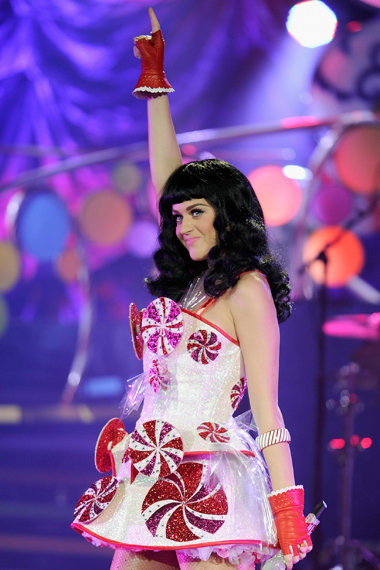
Home for the Holidays: Katy Perry Edition

As school vacation days roll into weeks, you’re probably looking for novel ways to keep yourself and the children entertained. Like watching Katy Perry: Part of Me on Netflix Instant. So I checked it out to see what parts she’s talking about exactly. Are they rated PG? The answer is a resounding Disney YES.
Instead of shooting whipped cream from her bra, for the purposes of The California Dreams Tour she goes with the more traditional candy cane uzi. Her dresses are pretty skimpy, sure,  but they take the form of lollipops and mermaids. If your children have been cleared for Barbie, and let’s face it, they have, they can proceed safely with Katy Perry: A Part of Me.
But what about me, the purported adult, you ask.  Will I be bored out of my mind? That all depends, surprisingly, on your position regarding French semiotics, particularly the concept of the simulacrum. Jean Baudrillard's concept of the simulacrum can best be understood in terms of the main street of Disneyland. What era or geography are these buildings meant to represent? Some sort of idealized mishmash; it doesn’t really matter. Disneyland has its own reality, which may in fact be preferable, or at least more hygienic than the real thing. You can visit the past; go to space, travel to New Orleans and visit the sacred cinematic space that is the Pirates of the Caribbean all on the family-oriented day. Are you seeing how this applies to Katy Perry’s songwriting? Please, try to keep up with your tour guide.
This is no mere concert film, this is a journey, produced by Academy Award ® winning producer Brian Grazer.  Like it or not,  as in The Pirates of the Caribbean films, there’s going to have to be a plot. Or the quest for a plot, punctuated by songs instead of swordfights. Let me walk you through some of the bright colored narrative ideas that float by in this giddy 93 minutes.
First story balloon: Katy Perry’s career represents a major break from her extremely religious, even puritanical family, who have disowned her for singing about kissing a girl. This narrative is the clear front-runner, since it’s been well-covered by the media. She was in fact from a family of traveling evangelical show people. Even fairy tales and Alice in Wonderland were considered too Satanic for the childrens’ consumption. Unfortunately, this fantastic storyline is blown to bits when we catch up with her mother and father chatting in Las Vegas. He has dyed brown hair and very dark sunglasses (indoors); he looks like a creep(ier?) Roy Orbison.  As traveling evangelicals they are fanatical, sure, but as show-biz insiders they can’t argue with success. We see them basking backstage at the show, in spite of the subversive mermaid action. (This in pointed contrast to Madonna’s dad in Madonna: Truth or Dare,  who seems to have had an entirely more virginal Madonna in mind.)
Second at bat storyline: Russell Brand and Katy Perry as true and potentially star-crossed lovers. This seemed like a very real possibility, based on what I’d read about the rockumentary when it came out. All that is tossed to the wind, however, once we spot the actual Brand backstage, and it becomes clear these “married” people are barely acquainted. But though they really don’t give us much to work with in the flesh, as the long-distance relationship starts to crumble and Brand files for divorce, this narrative arc starts to show potential. The perky Perry gets, like, exhausted and sad for a few nights and has to be coaxed onstage. There’s some crying. Given Brand’s subsequent interest in reforming politics and income inequality, it seems likely this was an early effort to undermine the evil plutocracy from within, one pop star at a time. Valiant, but abortive, as it turns out. Perry overcomes her malaise and returns in full Roar.
If you are going to get technical, that recent hit is not included in this 2012 show. Nor is it written or even "co-written" by Katy Perry. Nonetheless, its weird Toto/Muhammad Ali hybrid gets at something quintessentially KP, and gets us to our final storyline: Katy Perry’s artistic journey. We hear how the lonely young Perry, given a blue guitar (shades of Picasso?), worked at it tirelessly, rockin’ paens to Christ, mainly, to start with. Although her first single “Ur So Gay,” quickly sank, she did manage to hook up with master pop producers The Matrix (Avril Lavigne, Christina Aguilera, Britney Spears) and Glen Ballard (Alanis Morissette) early on. This is where this particular narrative gets confusing. We hear about Perry rebelling against efforts to make her into another Lavigne or Morissette and to find her own voice. But the songs themselves are very much a presence in the film, and they tell another story. They kept seeming extremely familiar, partly they were big hits (she holds the record for the most hits off one album with Michael Jackson), partly because all her songs sound alike, and partly because they are also wildly reminiscent of all the other pop divas currently on the scene. I kept having the thought, “Oh, I thought that was Kelly Clarkson, or Pink, or Britney Spears.”
There’s a reason for that, as it turns out. Her story is not so much finding her own voice, as finally hooking up with the right songwriting producer,  
Max Martin, who also turns out to produce every other female pop star of the moment. Our voyage of discovery turned out  not to be one of French semioticians but of Swedish pop producers! This is the troubling Nordic landscape in which we find ourselves. Truly, must everything become ABBA?

Tuesday, September 24, 2013

Salinger Review by Grace Lovelace (Six Degrees of Salinger)


J.D. Salinger writing Catcher in the Rye.


Shane Salerno’s Salinger arrives with many of the cheesy touches one would expect from a one-time Michael Bay collaborator, but also a feast of new information. Of particular interest are  a host of new images of Salinger himself, as well as interviews with one-time intimates. Following his death, everyone, is seems,  is anxious to spill the beans, to dance a little jig on the grave of Old Grey. This includes, surprisingly enough, fellow patriarchs of American literature such as E.L. Doctorow and Tom Wolfe. While it may cross our minds that these  writers have a strong financial interest in filmic representations of their books, and perhaps in cultivating relationships with producer Harvey Weinstein,  let’s set that aside for the moment. This is no time for our people hunting hat. (But, wait, what is Philip Seymour Hoffman doing here, pontificating on fame and artistic integrity? Is he starring in the upcoming biopic? And David Shields? He wrote the 800-page blockbuster tie-in, of course. Excuse my distractedness, my Holden Caulfield-brand bullshit detector keeps going off.)
There are, however,  some significant payoffs to the Weinsteins throwing their weight around. Here they are, in the order in which they appear:
1) An array of images of Salinger’s life as a soldier, like that above of “Jerry” working on an early version of Catcher in the Rye while on active combat duty. (He carried pages of the manuscript with him to the beaches of Normandy on D Day.)  Salinger, it seems, was part of a very tight-knit counterintelligence ring. They stayed in touch for the rest of their lives; some of them took pictures.
2) Footage of Jean Miller, the basis for the Esmé character  in  For Esmé—with Love & Squalor, Salinger’s breakthrough work for the New Yorker concerning a shell-shocked war veteran.  Fifteen when they met on a Daytona beach in the early fifties, she recounts how he pursued her until, on a weekend trip to Montreal she initiated sexual contact. The next day they were through.
3) A timetable and description of the unpublished Salinger works to be released  by the estate over the course of the next decade.
In terms of actual revelations, that’s pretty much it. For those paying attention, the Salinger fortress was breached years ago, stone by stone,  as memoirs were published  by his daughter and girlfriend. Rather than covering new ground, Salerno borrows liberally from these works, as well as from Kenneth Slawenski’s 2011 biography J. D. Salinger, which established  important connections between Salinger’s fiction and his largely untreated PTSD. Indeed, apart from the photographic scoops, Salerno’s  examination of Salinger’s war years appears pedestrian and without nuance in comparison to Slawenski’s book on the same subject. In particular, the short shrift he gives Salinger’s experience as a Jew who happened to be among first Americans to enter the concentration camps, and who , due to his fluent German, was additionally given the task of debriefing camp personnel, is a particularly grievous gap. Salinger’s subsequent nervous breakdown is covered in the film without the groundwork allowing us to understand why it happened. That’s Hollywood.
Salerno’s documentary has been criticized, most vocally by Maynard herself, for its cursory treatment of Salinger’s  long string of affairs with very young women. Having read Maynard’s memoir, the contrasts between the anger and angst-infused recollections of her book and her  affable persona in the film are striking. To give one example: in the film, she giggles as she remembers how they breakfasted, according to his strict views on health, on barely defrosted peas. Eccentric, yes, but also mildly charming. In the book, however, the story is a little different: She tells how  he was  always very controlling and dictatorial about  exactly what, and how much,  they ate. When one evening they consumed what he deemed too much, he tutored her in the art of self-induced vomiting. Yes, the fifty-three-year-old J.D. Salinger coached a very appearance conscious teen in bulimia! This is  sinister stuff; and, predictably, given the basically respectful tenor of the film,  it does not make Salerno’s cut.
In the end, Shane Salerno and J.D. Salinger make for an exceedingly odd couple. While Salinger, whatever his other faults, always had an exquisite ear, Salerno is fatally tone deaf.  The film has been widely criticized for its “America’s Most Wanted” style reenactment segments, but also, not incidentally, for it’s (mis)use of music. The climactic, ear-splitting Thus Spake Zarathustra-style orchestration  that overlays the exclusive list of books to be published is laughable, and ends up undermining the urgency of anything we learn. Things actually go downhill from there.  In the film’s final sequence, we are informed in breathless text (there’s no other way to describe it), that after years of intermittent filming in Cornish, the filmmakers received a phone call asking them to be at a particular corner at such-a-such a time. Very cloak and dagger. Once again the tabloid headline: “Exclusive: Last Known Footage of J.D. Salinger.” We then see an exceedingly frail J.D. Salinger make his way to a massive SUV. Taking his seat,  he grimaces manically (a smile?) through the window. He is then driven away by an oddly radiant and youthful redhead.Over this sequence plays jubilant music strongly reminiscent of the instrumental section in Peter Gabriel’s Solsbury Hill. Salerno’s message is clear: a moment of joyful reconciliation! At last!
To what is Salinger’s supposedly  reconciling himself? Salerno himself and/or the Weinstein Company? The droves of seekers who have showed up at his doorstep over the years? Perhaps something as grand as the culture at large; Salinger certainly suggests as much. E.L. Doctorow posits early on that becoming a recluse was simply a brilliant PR move on Salinger’s part, and various pilgrims tell their stories of how Salinger was not, in reality, all that unapproachable, even striking some as solicitous about their welfare.  
In spite of a certain narrative momentum to this understanding (He liked us! He really liked us!) unfortunately it makes precisely zero sense. Salinger’s decision to withdraw his work from the marketplace, in possession of a large and receptive reading public as well as an accommodating, remunerative publishers, even as he continued to produce novel after novel, remains utterly unprecedented. The SUV scene is simply another perplexing turn in an enormous mystery, the final maneuver of a crafty counterintelligence officer who never called off his war with the world. On the other hand,  it  does seem promising that several of the upcoming  books deal directly  with his war experience. Maybe a 50 year yoga retreat (another work is reputed to be a Vedanta religious manual) will turn out to be just what the doctor ordered. I for one am keeping the faith--a bit longer.
*Addendum: Following the enormously negative reaction to this film's original release, it was re-edited. As a result, the film you see on Netflix or PBS may be slightly different regarding music cues, etc. And it's apparently been given a new title.