Movies/ Mouthing Off/ A Miscellany

Movies/ Mouthing Off/ A Miscellany

Friday, January 31, 2014

Now on Netflix Instant: Lovelace Movie Review

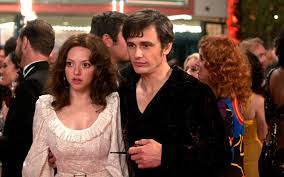
Amanda Seyfried as Linda Lovelace with James Franco as Hugh Hefner


     Naturally, when a movie called Lovelace came out it caught my attention, even if I didn’t feel the need to rush out and see it. First of all, it suffered middling to bored reviews, and secondly, this chick has already had her pound of flesh from me. If the film did well, it seemed to me,  I could be facing a future much like my past: blow job jokes from here to eternity. For this deep-throated interloper, born Linda Boreman, stole my name when I was but 5 years old!
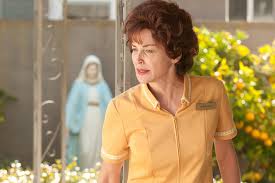
Sharon Stone as Linda Lovelace's repressive mother

       Thankfully, the flick sunk like a (sharon?) stone and I got my chance to see it for free-ish on TV not long after it came out. My Netflix Instant reviews usually involve a certain amount of Monday morning quarter-backing, and this one will be no exception. But before I get into all the things that rendered Lovelace a predictable commercial failure, I'll confess that I found it unexpectedly moving at times. But then again, I’m a Lovelace, always have been, always will be. "Linda Lovelace," on the other hand, died in a car crash in 2002 as Linda Marciano.
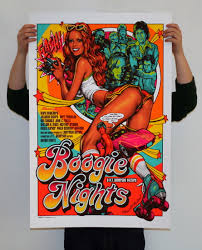
    In a time when we have all agreed to find the excesses of the Seventies delightfully daft, not to mention prettily promiscuous, Lovelace dares to be drab. In spite of the inevitable tacky bright prints worn by the actors, this is a  film largely drained of color, with a brownish wash over the whole thing. This is not Boogie Nights,  nor is it the Academy Award nominated American Hustle.       
  
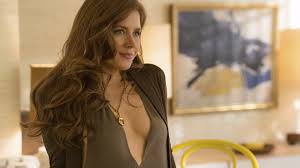
Amy Adams in  American Hustle
              
Amanda Seyfried does show her breasts, but briefly, and in dispiriting circumstances. There is nothing remotely like the kick of Heather Graham  skating topless as Roller Girl. And in place of the radiant Amy Adams, Seyfried is shrouded in dyed dark hair, dark contact lenses and prominent freckles (Lovelace was no looker).  In the latter portions of the film, she’s shrouded in feminist shrouds.
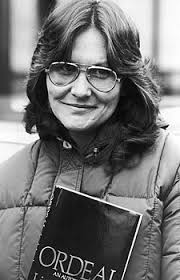


Linda Lovelace in the second half of her career, as an anti-porn activist
  
The music in Lovelace, while prominent, is not joyful or nostalgic, as in the other, more successful throw-back films, but is used mainly as ironic counterpoint to the action on screen (that is, we might get a groovy song like Ring My Bell while Lovelace is getting gang raped). Actually, I made that up; I mean the actual song, not the ironic counterpoint or the gang rape. While American Hustle has Elton John songs, used to soaring, almost operatic effect, Lovelace doesn’t feature instantly recognizable period hits. “Spirit of the Sky,” played while she gets her first lesson in fellatio, is the most recognizable by far and the only one I remember.
    Where American Hustle celebrates the scrappy art of the small time hustler (very 70s!), the real life hustler of Lovelace, her husband and sometimes pimp, Chuck Traynor, is far from sympathetic. He’s much closer, in fact, to the real life Paul Snider, the subject of Star 80. As played by Eric Roberts Snider was an unattractive fellow, dangerous when cornered, culminating in the ugly rape/murder scene of Playmate Dorothy Stratten. Lovelace, while not nearly as accomplished Star 80, is close in spirit to Fosse’s film, and  is similarly concerned with the dark side of the sexual revolution industry. There is deliberate overlap between the two films, as Eric Roberts makes an appearance here administering the polygraph Lovelace must pass for her publishers. Hugh Hefner, a pivotal presence in Star 80, appears in Lovelace as well (played by James Franco), reinforcing that film’s disturbing notion that even that most air-brushed, lucrative branches of the porn industry, such as Playboy, demand a de facto farm team of small-time hustlers, pimps and prostitutes to draw from.  Or Gypsies, Tramps and Thieves, if you want to get Cher about it.
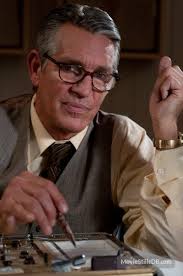

Eric Roberts in Lovelace
The only thing experimental about this earnest film lies in its unusual structure: the first half treating Lovelace’s rise to celebrity, the second half deconstructing that rise from her later perspective, as expressed in Ordeal. As I recall, this structure was widely criticized, with critics asking which version we were supposed to believe. I disagree, however;  I don't find the two versions all that hard to reconcile, and the shift in tone seems true to my lived experience of her story. The first I heard about her was as a child, with adults giggling naughtily at the name Lovelace (mine). This Linda Lovelace seemed fun if slightly threatening. By the time Ordeal came out I was 13; this time around her name seemed to signify something grim and possibly fraudulent. It was strange to be reminded of the widespread resistance to Lovelace’s memoir when it came out. What I find astonishing at this point is that people found her story hard to believe. Her story in fact seems familiar to the point of inanity:  that she had come from an unhappy family, met a charming man who made her promises about a new life and stardom but instead fed her drugs and got her involved in prostitution, leading, eventually, to Deep Throat. Jeez, what bombshell will she drop on us next, that her clitoris isn't really in her neck?
    Deep Throat marked the moment when porn entered mainstream American culture. The story Lovelace tells about that moment is not one we particularly want to hear in 2014, when images that would previously have been considered X-rated now hover over public thoroughfares, selling everything from vodka to the plastic surgery you'll evidently need in order to participate. (I'm talking about old-fashioned billboards, but of course our electronic byways are largely porn-powered.)  As I navigate my own daughters along Pacific Coast Highway, I feel moments of sadness about where we're going. And the sadness doesn’t lift, not even as the bouncy, disco-infused “Blurred Lines” comes on the radio.


--Grace Lovelace

Sunday, January 19, 2014

2 Days in New York: Netflix Instant Review


     Whilst perusing the appraisals of my colleagues, A.O. Scott and Roger Ebert regarding the film 2 Days in New York (director and partially written by Julie Delpy)  I am left wishing, not for the first time, I were blonde and/or French. This film, to which I would unhesitantly apply the critical term "serious sack o' merde," instead is inexplicably coddled as "a charming mess" (Scott), who furthermore finds Chris Rock (the one intermittently funny element in the film) a cold and rejecting partner  to the multi talented and bilingual Delpy.  Ebert, too, rewarded this flimsy effort with an obscene number of stars (3 and1/2 out of 4). Au contraire, mon freres.
   Looking over their work I'm concerned, too, that I don't tell you enough of the plot. But do you really need to know that Delpy and Rock work for "The Voice" (local color),   she as a photographer and he as a cultural critic, and that he has not one but two radio shows? Or that her family is visiting from France, her mother has recently died, and her photography exhibit opens that weekend? As far as I'm concerned, these details are beyond the scope of duty, yours or mine, as are the names of the Rock/Delpy characters. Isn't it enough to say there are beaucoup jokes about rude, stinky French people, and that the most entertaining thing for me in the first forty minutes was figuring out which of their children (from previous relationships. There, I told you something plot-related) is named Willow and which is Lulu, and whether the small blond toddler (named Lulu!) could possibly be a boy. Oh, and what the hell Chris Rock is doing in this amateur hour. Isn't he a big star or something?
     Perhaps, as Scott points out, he seems disgruntled here beyond the strict demands of the role. Is he really supposed to be disgusted beyond the point of return by the French sister and her boyfriend using his electric toothbrush as a sex toy? Because we have a long way to go. But I'm fine with it, because he provides, either by improvising lines or simply by his delivery, a few, if not laughs, then smiles. Something existentially missing from all the madcap Franco-American blather.
     In its own way, Netflix is a time machine. Not the cool kind, that takes you back to another century or millennium, but a more modest sort that delivers you 18 months in the past. Time enough, however, to separate the wheat from the hype, and, given the interim passing of Roger Ebert, to remind us that we don't have time for this nonsense.
     Through my Netflix time wormhole,  I would also urge 2012 Julie Delpy to calm down. In spite of her well-founded anxiety--based on a scene where a critic savages her photography exhibit as poorly executed and not showing her tits enough--that she's producing a stinker here,  she will move on to the well-regarded Before Midnight in 2013. She will do fine work as a writer and actress; she will show her tits; she will be nominated for a Golden Globe.
      .
Update 2014: She won't win.

Sunday, January 12, 2014

The Guilt Trip: Netflix Instant Review


     It seems to me there should be a more relaxed standard for measuring Netflix Instant films. The theatrical experience, involving as it does significant outlay of cash, as well as dragging your ass to a crowded venue with possible gunplay, quite naturally demands a definitive thumbs up or thumbs down. But the home theater experience seems to call for something a little less definitive, say a stick figure reviewer in various degrees of proneness on a sofa. Eyes open, strictly optional.
     When The Guilt Trip was released in 2012 it was savaged by the critics as predictable and lame, but on a leather recliner with dog and husband, the film reveals new virtues. In what must be one of the most mellow road trips of all time, Seth Rogen and Barbra Streisand cross the country together as he tries to market a new organic cleanser that he, a chemist, has devised. Now, don't get me wrong, this plot is deeply tiresome. I can tell you most of the ingredients that go into "ScieOClean" -- coconut and soy and something else, maybe cilantro -- because we are inexplicably forced to watch his spiel again and again.  Yet even here, the weak point of the film, I see a metaphor for the gentle pleasure of The Guilt Trip; in place of the corrosive, blasted hilarity of the Fockers or Hangover comedies, the films that it most readily suggests, this movie does its job gently, in an environmental and nap friendly manner.
     The joys of  The Guilt Trip lie almost entirely with its two principals,  Barbra Streisand and Seth Rogen. While not a huge Babs fan, I do recognize her legendary status, and I have grown up alongside that legend. The movie has a lot of fun with her persona. Instead of Barbra the accomplished perfectionist, renowned connoisseur and world traveler, we get the thoroughly mundane Joyce Brewster, who delights in trips to the Gap and collecting ceramic frogs. Streisand revels in  a series of unflattering jogging suits and t-shirts. Is she wearing a fat padding? Probably, but I dearly hope not. In short, Streisand's constantly undercutting of her own grandiose image provides a reliable frisson of pleasure throughout this low-key effort. And Seth Rogen has crept up on me as a wry and charming leading man. What other Hollywood man would get all buff to play a purposefully stupid  superhero sendup, in The Green Hornet? Or work repeatedly with women directors, like here, or play nice in other female-centered comedies like Knocked Up? The dude evinces a laudable ability to be simultaneously funny and sane. Maybe because he's Canadian. In any case, he's welcome on my couch any time.
     The Guilt Trip is not high art, but it has enough odd turns and small scale satisfactions for the Netflix experience, especially, I suspect, for those born in the years B.S. to A.B. (Before Seth but After Babs). Happy cocooning.
--Grace Lovelace

Saturday, December 28, 2013

Home for the Holidays: Katy Perry Edition

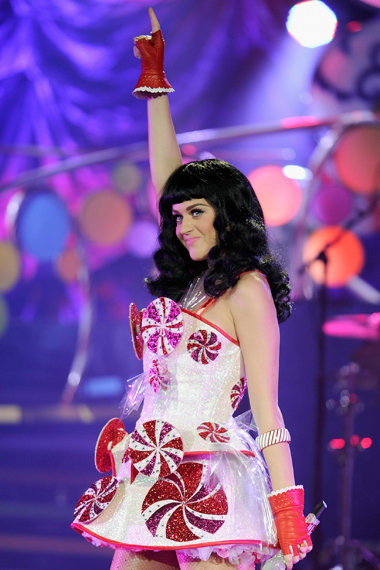
As school vacation days roll into weeks, you’re probably looking for novel ways to keep yourself and the children entertained. Like watching Katy Perry: Part of Me on Netflix Instant. So I checked it out to see what parts she’s talking about exactly. Are they rated PG? The answer is a resounding Disney YES.
Instead of shooting whipped cream from her bra, for the purposes of The California Dreams Tour she goes with the more traditional candy cane uzi. Her dresses are pretty skimpy, sure,  but they take the form of lollipops and mermaids. If your children have been cleared for Barbie, and let’s face it, they have, they can proceed safely with Katy Perry: A Part of Me.
But what about me, the purported adult, you ask.  Will I be bored out of my mind? That all depends, surprisingly, on your position regarding French semiotics, particularly the concept of the simulacrum. Jean Baudrillard's concept of the simulacrum can best be understood in terms of the main street of Disneyland. What era or geography are these buildings meant to represent? Some sort of idealized mishmash; it doesn’t really matter. Disneyland has its own reality, which may in fact be preferable, or at least more hygienic than the real thing. You can visit the past; go to space, travel to New Orleans and visit the sacred cinematic space that is the Pirates of the Caribbean all on the family-oriented day. Are you seeing how this applies to Katy Perry’s songwriting? Please, try to keep up with your tour guide.
This is no mere concert film, this is a journey, produced by Academy Award ® winning producer Brian Grazer.  Like it or not,  as in The Pirates of the Caribbean films, there’s going to have to be a plot. Or the quest for a plot, punctuated by songs instead of swordfights. Let me walk you through some of the bright colored narrative ideas that float by in this giddy 93 minutes.
First story balloon: Katy Perry’s career represents a major break from her extremely religious, even puritanical family, who have disowned her for singing about kissing a girl. This narrative is the clear front-runner, since it’s been well-covered by the media. She was in fact from a family of traveling evangelical show people. Even fairy tales and Alice in Wonderland were considered too Satanic for the childrens’ consumption. Unfortunately, this fantastic storyline is blown to bits when we catch up with her mother and father chatting in Las Vegas. He has dyed brown hair and very dark sunglasses (indoors); he looks like a creep(ier?) Roy Orbison.  As traveling evangelicals they are fanatical, sure, but as show-biz insiders they can’t argue with success. We see them basking backstage at the show, in spite of the subversive mermaid action. (This in pointed contrast to Madonna’s dad in Madonna: Truth or Dare,  who seems to have had an entirely more virginal Madonna in mind.)
Second at bat storyline: Russell Brand and Katy Perry as true and potentially star-crossed lovers. This seemed like a very real possibility, based on what I’d read about the rockumentary when it came out. All that is tossed to the wind, however, once we spot the actual Brand backstage, and it becomes clear these “married” people are barely acquainted. But though they really don’t give us much to work with in the flesh, as the long-distance relationship starts to crumble and Brand files for divorce, this narrative arc starts to show potential. The perky Perry gets, like, exhausted and sad for a few nights and has to be coaxed onstage. There’s some crying. Given Brand’s subsequent interest in reforming politics and income inequality, it seems likely this was an early effort to undermine the evil plutocracy from within, one pop star at a time. Valiant, but abortive, as it turns out. Perry overcomes her malaise and returns in full Roar.
If you are going to get technical, that recent hit is not included in this 2012 show. Nor is it written or even "co-written" by Katy Perry. Nonetheless, its weird Toto/Muhammad Ali hybrid gets at something quintessentially KP, and gets us to our final storyline: Katy Perry’s artistic journey. We hear how the lonely young Perry, given a blue guitar (shades of Picasso?), worked at it tirelessly, rockin’ paens to Christ, mainly, to start with. Although her first single “Ur So Gay,” quickly sank, she did manage to hook up with master pop producers The Matrix (Avril Lavigne, Christina Aguilera, Britney Spears) and Glen Ballard (Alanis Morissette) early on. This is where this particular narrative gets confusing. We hear about Perry rebelling against efforts to make her into another Lavigne or Morissette and to find her own voice. But the songs themselves are very much a presence in the film, and they tell another story. They kept seeming extremely familiar, partly they were big hits (she holds the record for the most hits off one album with Michael Jackson), partly because all her songs sound alike, and partly because they are also wildly reminiscent of all the other pop divas currently on the scene. I kept having the thought, “Oh, I thought that was Kelly Clarkson, or Pink, or Britney Spears.”
There’s a reason for that, as it turns out. Her story is not so much finding her own voice, as finally hooking up with the right songwriting producer,  
Max Martin, who also turns out to produce every other female pop star of the moment. Our voyage of discovery turned out  not to be one of French semioticians but of Swedish pop producers! This is the troubling Nordic landscape in which we find ourselves. Truly, must everything become ABBA?

Sunday, December 15, 2013

The Real Estella by Grace Lovelace


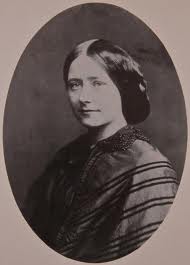
Ellen “Nelly” Ternan at 19, a year after meeting Charles Dickens.


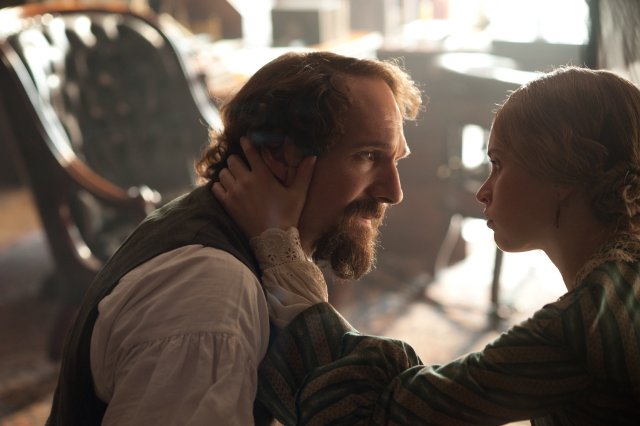
Like the work of Charles Dickens itself, The Invisible Woman, the new film about Dickens’ mistress Ellen Ternan, is more radical than it appears. The 45-year-old Dickens met Ellen “Nelly” Ternan, 18,  when she appeared in a play he was producing and starring in. She stepped into the role previously played by his daughter Kate, as he decided to take the show on the road. She also became his companion for the next 12 years, his last.
Nelly Ternan has generally been treated as a somewhat ambiguous footnote to Dickens’ life. In this, his biographers took their cue from Dickens himself, who expended great energy wiping out the traces of his late life love affair. A famous man in mid-life spends enormous time and money on a pretty young actress? Generations of Dickens’ scholars have found this behavior unreadable. “Family friend,” had been the somewhat gingerly consensus, at least until the English biographer Claire Tomalin stepped in with her 1990 book on Ternan, her family, and their association with the  famous novelist.
Then, as now, the theater represented a sort of liminal space, on in which real world rules don’t always apply. Actresses, too, as Tomalin explains, though disapproved of, were also allowed unusual liberties. While regarded as outlaws, with an inevitable aura of prostitution, they were also, when successful, granted a remarkable degree of autonomy in Victorian England,  frequently moving between relationships or having children with different partners, within or without marriage. Nelly came from a well-established theatrical family, with roots and connections. She also seemed quite young and innocent, most people agreeing she seemed more immature than her 18 years. A potent combination, as it turned out, when it came to Charles Dickens.
For Dickens, the putting on of plays seems to have filled a number of purposes: providing an at least temporary escape from his by then unhappy marriage, and an opportunity to hang out with his Bohemian friend, Wilkie Collins. (Collins wrote the play, The Frozen Deep, in which Ternan and her sister appeared. He was also involved in many of Dickens’ other theatrical endeavors.)  A fellow novelist (The Moonstone, The Woman in White), Collins was also a notorious rogue:  a connoisseur of actresses, in fact, maintaining several households over his adulthood, while remaining unmarried. A man of the continent and of the theatre, he was the perfect companion for the restless Dickens, enacting freedoms the infinitely more famous, and famously virtuous Dickens could not allow himself.
When he eventually decided to sack his wife, Dickens seemed to have encountered surprisingly little resistance. He simply spun the story to his advantage. His wife, he wrote to the papers, had never taken an interest in the children, though she bore him ten. She was cow-like and crazy, he claimed, an unfit companion for his genius. According to Claire Tomalin’s The Invisible Woman, from which the film is adapted, she was pensioned off to a small house north of Regent’s Park, away from the rest of the family. Georgina Hogarth, her sister, who had long enjoyed a position of power and favor with her celebrity brother-in-law, was happy to officially become matron of the house. She also publicly backed Dickens claims.
Dickens turned out to be quite masterful in shaping his public image, even well after his death. The beloved Dickens of a Christmas Carol didn’t just happen, he needed producing and stage managing. To that end, he blackmailed, wrote in code, used pseudonyms and most of all, burned anything incriminating and ordered others to do the same. His daughter Kate, writing much later to George Bernard Shaw, said she looked forward to letters surfacing “in which the real man is revealed, minus his Sunday clothes and all shams, and with his heart and soul burning like jewels in a dark place! I say there may be such letters and they may be one day given to the world” (quoted by Tomalin, p. 236). As it turned out she underestimated the extent of her father's control.
But history, like family, is an unruly thing. When Tomalin began to fill in the missing pieces, there were plenty of clues to be found. Ralph Fiennes takes up this material, as adapted by screenwriter Abi Morgan (
The Iron Lady), to give us a life not so much invisible as willfully erased. Tomalin’s Invisible Woman reads like a detective story; the drama lies in piecing together the evidence into the most likely scenario. What does it mean for a Victorian couple to disappear to France, as Dickens and Nelly appear to have done?  She posits that Ternan became pregnant and was spirited away to a morally flexible Gallic retreat, rather a tradition for English gentlemen of the period. Financial records for leases and sums of money under false names, frequent appointments with “N” in a lost appointment book? Along with testimony from Dickens’ children, several of whom made sure to go on the record before their deaths, the story of Dickens and Nelly Ternan began to take shape.
     While covering the same material, Fiennes movie takes a somewhat different approach.  His film, detailing the somewhat mercenary arrangements of an influential Victorian figure, plays out against our expectations for a love story, specifically one about an artistic couple  bucking convention. There’s not much transcendent here, the film makes clear, and Dickens alone had sufficient power to alter conventions to his own needs.
Fiennes gets a lot across of this across, very economically, in the early scene rehearsing The Frozen Deep.  His own theatrical experience, as well as growing up in a large, artistic family, no doubt came in handy. The casting is particularly effective: Felicity Jones, a young British actress unfamiliar to me, is attractive and fairly effective, but clearly unable to compete in terms of star power with her elder co-stars, evoking her youth and experience in what must have been an overwhelming situation. Ralph Fiennes plays Dickens and, in an extremely clever bit of casing, Kristin Scott Thomas is Nelly’s mother, Fanny Ternan. We cannot help but be reminded of their archetypal love story together, The English Patient, every time they are together in a scene. But now Thomas has been transformed to chaperone and somewhat unwilling broker. A sense of things are askew, of displacement, is the effortless result of this particular reunion.  Kristin Scott Thomas is flawless, as usual. She conveys a weary grasp of the situation, as well as a determination not to let it veer out of control. If there is a weak link, in terms of the acting, it is Fiennes himself.  When I first heard he was playing Dickens, I found it hard to imagine; how could this slow-moving, introspective actor play the tiny, hyper Dickens? (The very best man for that job, it strikes me, would have been Willy Wonka era-Gene Wilder. He alone could convey his manic vision and zany leadership style. And the costumes could essentially remain the same.) Though Fiennes acquits himself as Dickens, his acting in this film does not rise to the level of his directing.
When Nelly has been discussed as part of Dickens’ public life, it has been as the inspiration for Estella in Great Expectations, his late, great novel writing during this time. Although she may have initially appeared to him as a figure of virtue and passivity, in the long term he seems to have found her, and her family, rather less pliable.  Estella, an intractable beauty controlled by powerful backstage forces: this  does seem to bear some resemblance to his dealings with the Ternan clan. In the beginning he used his influence to get them parts and rent them houses; as time went on he procured her older sister Fanny a position as governess to Anthony Trollope’s widower brother, a job that quickly morphed into wife. Fanny began to publish regularly, at top prices, in Dickens publication All the Year Round. In the twelve years of his association with the family, before his death, they established themselves quite firmly in the nexus of his financial and literary connections. Later historians had grounds to wonder is this family was simply one of his ongoing charitable endeavors; they seem to have represented a package deal.
If at times these Ternan claims may have seemed onerous, they did confer one real advantage to Dickens: once established in respectable marriages, the Ternans were just as anxious to hide the true nature of the connection as he was himself. The extent to which Nelly was erased from the official Dickens story was due, largely, to her own efforts.
Nelly seems to have picked up Dickens knack for fictionalizing her own life. After his death she shaved a neat decade of her age, conveniently refreshing her maidenhood to marry a much young clergyman. Together they founded a school, coincidentally in Margate, the setting for much of Dickens’
Great Expectations.  She also had a son. Scenes from her life in Margate punctuate the film, which is told in flashbacks. These scenes of her helping to run the school, striding along the shoreline, and staring moodily into her first editions of Dickens, are some of the film’s weakest. Part of the point seems to be to establish the connection between Nelly and the real life elderly local cleric, coincidentally a huge Dickens fan, to whom she confided her secret and who eventually spilled the beans, establishing one of the important links in the chain of Nelly evidence. But this legalistic accounting, evident too in the scenes regarding Nelly’s probable stillbirth (closeup on Dickens signing the French death certificate, using one of his many Nelly-related pseudonyms), sits uneasily with the doomy romanticism.
After Dickens is gone, so too, largely, is the point of the film. Pasting in what are basically sequences from The French Lieutenant’s Woman does not, unfortunately, add depth to the portrait of Nelly Ternan, who seems to have been in point of fact  proactive in the extreme, not at all prone to depressive trances on the pier. She went on to live to a very old age, the Dickens relationship only discovered by her son much later, as he attempted to make sense of the financial records and mementos she left behind.
I saw this film as part of a series of early  industry screenings, accompanying my sister, who happens to be a SAG member. The showing of The Invisible Woman was sparsely attended, there was muttering about boredom on the way out. Very much in contrast to the later showing of  Out of the Furnace , the testosterone and violence fueled vehicle featuring powerhouse performances by Christian Bale, Woody Harrelson, and Casey Affleck, as well as a standard bit part by Zoe Saldana as girlfriend/pre-school teacher. “Brave!” and “startling!” was the consensus on that one. The Invisible Woman is a small movie, not a perfect one, but it is unusual in having a genuinely feminist vision. From where I sit, that is startling.


Tuesday, November 12, 2013

Talkin' Orson Welles Blues by Grace Lovelace


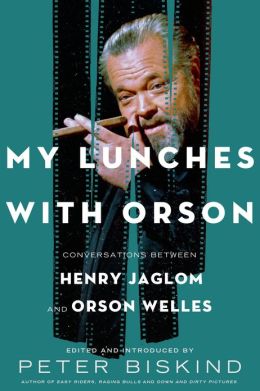
My Lunches with Orson.Conversations between Henry Jaglom and Orson Welles. Edited and with an Introduction by Peter Biskind. Henry Holt and Company, 306 pp., $28


In this collection of short lunchtime talks--tapas, if you will-- you get the kind of Rabelaisian stream-of-consciousness concoction that could only be delivered by a man wearing “bifurcated tents to which, rather idly, lapels, pocket flaps, buttons were attached in order to suggest a conventional suit.” (Gore Vidal’s memorable description of Orson Welles’ late-era costume, as quoted in Peter Biskind’s introduction.) Within the ambiance of late-seventies-early eighties Ma Maison we are treated to a series of conversations between two champion talkers--the legendary Orson Welles, and his spunky sidekick Henry Jaglom. (For the record, while I’ve always been underwhelmed by Henry Jaglom’s films, he proves a stimulating foil to Orson Welles here.) The waiters come and go; celebrities mingle; meanwhile the history of Hollywood’s golden age is recounted, in swift and sometimes spiteful bursts, by one of the world’s master storytellers.
I must say, I loved this book so much more than I expected. The conversations, taped at Orson Welles request by Henry Jaglom, have been masterfully edited by Peter Biskind. We get the most delicious, unfiltered gossip, but also a sharp sense of environment. Most importantly, a character emerges: the aging boy genius, still pushing for the next big project, but in the meantime enjoying leisurely meals and angling for another lucrative commercial. (These were the Paul Masson years, after all; a contract which provided Welles major income for this period. In an amusing aside, he talks about how low-rent the Masson advertising execs were, and how much they resented his automatic attempts to improve the copy even as he spoke it.)
We learn about the evolution of Hollywood through the prism of the Ma Maison chicken salad:
OW: Don’t get tiresome about the chicken salad.
HJ: Why am I being tiresome, Orson? I want to get it the way it always is, without the capers. The waiter doesn’t understand.
OW: This is the way the chef makes it now.

HJ: They keep writing in the papers that, ever since Wolfgang left, this place has gone downhill. And his restaurant, in turn, has become the number-one one. He’s begging me to get you to come to it.
OW: I’ll never go.


HJ: Why?

OW:: I don’t like Wolgang. He’s a little shit. I think he’s a terrible little man.
HJ: Why?
OW: I don’t know. God made him that way. What do you mean, “Why?”


And against the bustling restaurant backdrop, celebrities are sighted, summoned, gossiped about and rebuffed. Jack Lemmon stops by and chats for a chapter. Richard Burton and Liz Taylor are sent back to their own table, much to Henry Jaglom’s chagrin. The two friends touch on innumerable topics drawn from Welles 50+ years on the public stage, but, inevitably, certain names keep floating to the surface: John Houseman, enjoying a maddening career surge at the time, consistently unkind to his former Mercury Theatre partner; Rita Hayworth, partly because of Jaglom’s fascination with Welles’ gorgeous former wife;  Citizen Kane, of course; and, most amusingly, Welles main Shakespearean competition, Laurence Olivier.  In Welles’  book, this book,  no one could be stupider, vainer, or foist more pig-headed interpretations on an innocent public than “Larry”:
HJ: How is Larry? Has anyone heard anything more about his health?
OW: I hear all kinds of stories, none of them very cheerful. He has three kinds of cancer. It’s particularly a shame, because Larry wanted to be so beautiful. I caught him once, when I came backstage to his dressing room after a performance, he was staring at himself with such love, such ardor, in the mirror. He saw me over his shoulder, embarrassed at my catching him in such an intimate moment. Without missing a beat, though, and without taking his eyes off himself, he told me that when he looked at himself in the mirror, he was so in love with his own image it was terribly hard for him to resist going down on himself. That was his great regret, he said. Not to be able to go down on himself!
This is a big ego, but surprisingly, the flip side of that ego is a major fragility and, frequently, an open-heartedness and compassion towards the other players. For example, it’s obvious both Jaglom and editor Biskind want him to strike back at Pauline Kael, who, in truth, did him a gross disservice in her essay on Citizen Kane. When Jaglom brings it up,  Welles just nods--she was wrong--but continues, “I love Pauline, because she writes at length about actors. Which nobody writing about movies does. II think she’s wrong a lot of the time, but she’s always interesting.” .Refreshing, particularly given the venom regularly directed her way by powerful men who found themselves on  the business end of her pen.
The book conveys the depressing hustle of Welles late career, as Jaglom and he plot his next move, only to meet disappointment after disappointment.  Jaglom, to be honest, seems more hopeful about the prospects than Welles at this point, who is always glimpsing the failure in any possible success. This portion of the book reaches it’s heartbreaking nadir in a meeting with an HBO exec who offends Welles with her indifference. “When I get that dead look, I’m dead!, he fumes.” “I can’t do it.” We witness the whole sorry thing.
His fatal ADD is on full display in these Ma Maison lunches, it’s true; but so too  is the brilliance that allowed him to shrug off one of the greatest movie of all time at age 25.

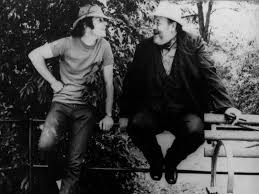
Henry Jaglom and Orson Welles

Tuesday, October 15, 2013

A Blog for Every Crackpot by Grace Lovelace

Joseph Gordon-Levitt directs Don Jon.


Your mom calls you up, urging you to see the Joseph Gordon-Levitt movie about porn addiction. For your new blog, she says. You suspect you’ve hit rock bottom.
Relax, Jay McInerney, because it turns out that Don Jon is an extremely wholesome porn addiction comedy, the kind your mother could (and evidently does) love. Stocked full of vitamin rich Positive Attitudes Toward women, and low in nasty saturated-fat Laughs. Indeed, there is a sensitive, seventies vibe about the whole thing--you’d swear it arrives covered in sprouts, or remnants of that ancient human artifact, pubic hair.
This in spite of it’s contemporary, Jersey Shores milieu. Joseph Gordon-Levitt plays  the bartending womanizer of the film’s title. (He also wrote and directed.) He has met the woman of his dreams (Scarlett Johansson) but they are both beginning to suspect his heart really belongs to internet porn. Into this troubled scenario arrives Julianne Moore as an emissary from another era, much like Jane Fonda in Coming Home. She will rehabilitate him, not from the Vietnam War, but from his porn-fueled compulsive self-stimulation. Reader, they make love.
In one of many jabs at conventional romantic comedy,  it turns out that Barbara, the Scarlett Johansson character, is addicted to her own voracious fantasy life--a retro, coercive marriage track symbolized by her rapt consumption of the romantic films she drags him to-- films that bore him stiff, even as she finds his porn completely disgusting. These female fantasies are just as destructive of real-life happiness, Gordon-Levitt implies, as the more obvious objectification of porn. Considering the degradations I’ve suffered at the hands of rom-coms over the years, I can only, wearily, concur.
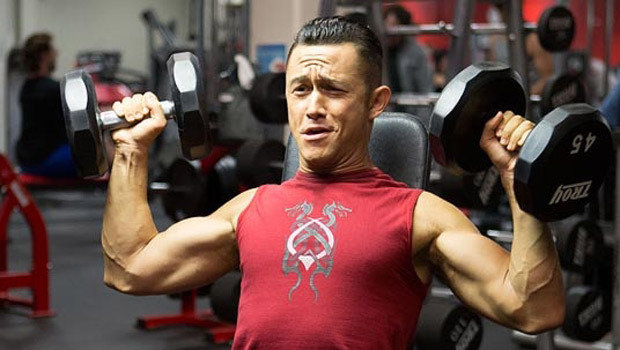
Gordon-Levitt has always been likeable, in movies like Inception and 500 Days of Summer, and I was rooting for him as he works to break out of side-kick status, to transform himself not just  into leading man but auteur. He literally flexes his muscles, expands and hardens here in his role as an emotionally closed-off body builder. ( I really have no idea how he got those muscles.) And then he turns himself back again, into a sensitive listener, sans hair gel and in-your-face attitude. By the end of the film, he’s practically eating quiche.
In a lot of ways, Don Juan reminded me of another recent vehicle by an actor turned writer-director, Lake Bell’s In Another World, in which she shed her typecasting as a  beautiful, demanding vixen in order to play a voice-over nerd in overalls. In both cases the premises seem kind of original, the messages worthy, but the laughs were pitiably few and far between. Even though the triple-hyphen credit (actor-writer-director) looks fabulous, and the multi-tasking undoubtedly saves money, these wunderkinder should maybe have sprung for a writer-writer, or at least  some kind of joke technician.
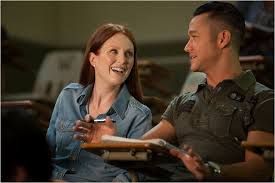
Julianne Moore joins Joseph Gordon-Levitt in class .


Don Jon was redeemed for me, however, by the presence of Julianne Moore. Her character is, I suppose, as big a stereotype in its way as Gordon-Levitt’s macho Saturday Night Fever character or Scarlett Johansson’s poison sex-pot. She is middle-aged and unstable, also terribly chic, sexy, and beautiful. In short, she’s Julianne Moore. But I give Gordon-Levitt extra credit for this particular twist in the romantic comedy genre: it’s not often Scarlett Johansson gets rejected in favor of a stoned nutcase twenty-five years her senior.
Go ahead and call me a sucker for falling for Manic Pixie, Mrs. Robinson division. Do you think it bothers me? I’m already sitting here writing a movie blog for my immediate family. That reminds me, my sister said the last one was was way too long. Time to wrap things up.

Let’s do the time warp again soon. Love, Actually